


Blue-green algae recently reported on Horseshoe
Blue-green algae recently reported on Horseshoe
What are blue-green algae?
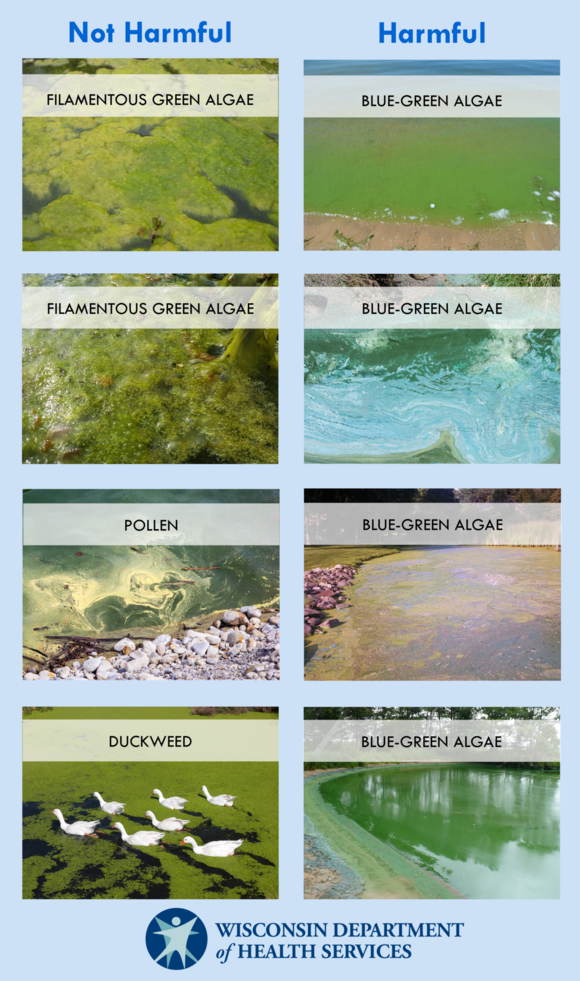
Though commonly referred to as algae, blue-green algae are actually not algae, but are types of bacteria called cyanobacteria. They are often present in bodies of water in Minnesota. This type of bacteria thrives in warm, nutrient-rich water. When conditions are right, the blue-green algae can grow quickly forming blooms.
Certain varieties of blue-green algae blooms can produce toxins that are linked to illness in humans and animals. Avoid swimming or wading in water that appears to have a blue-green algae bloom. If you do come in contact with algae-laden water, wash with fresh water afterwards.
How can we get rid of harmful algae blooms?
We can't eliminate blue-green algae from a lake — they are an inherent part of the overall algal community. What we really want to do is control the overall intensity and the frequency of the blooms. Since we can't control the water temperature, the best thing we can do is to reduce the amount of nutrients entering the lake. This can be accomplished by reducing the amount of phosphorus and nitrogen from man-made sources such as lawn fertilizer, runoff from cities, cultivated fields, feedlots, and a myriad of other sources.
For homeowners on the Chain, there are several things you can do to help. The easiest is to avoid fertilizers near the water - particularly those with phosphorus. Another thing to consider is the installation of a native buffer zone along your shoreline to filter out undesirable nutrients before they run into the lake and promote algal growth. SRCLA offers subsidies to shoreline owners for projects like native buffers, as does the Stearns Conservation District.
Please contact Rick Reimer, Land Use Lead, at rick.reimer64@gmail.com if you’d like to discuss options.
Though a reduction of nuisance algal blooms will not be immediate, it is the best long-term solution to minimize the frequency and intensity of algal blooms.
For more information, including how to identify and test, see this page from the MN Pollution Control Agency: https://www.pca.state.mn.us/air-water-land-climate/blue-green-algae-and-harmful-algal-blooms

NO WAKE RESTRICTIONS
The Sheriff’s Department has declared NO WAKE within 300 feet of any shoreline.
As everyone gets ready to enjoy some much-needed lake time, here are three reminders heading into the holiday and some updates prompted by recent rains.
First: The Sheriff’s Department has declared NO WAKE within 300 feet of any shoreline until water levels recede - this one DOES impact the chain.. This is a shift from the voluntary no-wake last week now that water levels have increased even more. Please remind your family, friends, and any visitors you may host this holiday weekend. It may be helpful to visualize 300 feet as the length of a football field. And since many parts of the Chain are less than 600 feet in width, some narrow channels will effectively be fully no-wake until you arrive at a larger basin. "Slow-no wake" means the operation of a watercraft at the slowest possible speed necessary to maintain steerage, and in no case greater than 5 MPH. https://www.revisor.mn.gov/rules/6110.1200/
Second: Watching your docks and lifts? Keep an eye on any changes using our gauge on Horseshoe.
Third: The new boating law is now in effect. The new requirement for Youth Water Operators’ Permit went into effect July 1. Anyone 21 or younger must have a valid watercraft operator's permit. Even with a permit, please talk with the watercraft operators in your household about the need to own your wake. https://www.dnr.state.mn.us/safety/boatwater/boater-education-law.html